
Key takeaways
- Landlord's work is what the landlord builds at its cost; tenant's work is everything else, at yours.
- Anything not written into landlord's work is, in practice, the tenant's responsibility.
- "As is" delivery, permit-triggered code upgrades, late landlord's work and restoration are the usual sources of disputes.
- When a landlord funds tenant's work, Ontario's Construction Act exposes it to liens up to 10% of that funding.
01 — Definitions
Landlord work vs. tenant work: the two schedules in your lease
Most commercial leases in Ontario attach a description of the work each side will do before the tenant opens. The names vary, but the idea is the same.
- Landlord's work is the list of items the landlord must complete at its own cost, before or shortly after the commencement date. Thompson Dorfman Sweatman's guide to offers to lease puts it simply: the tenant should check that list to confirm it covers what the business actually needs.
- Tenant's work is everything else needed to make the premises ready for your business: partitions, ceilings, finishes, millwork, specialized mechanical and electrical, signage. It is done at your cost, by your contractor, usually with the landlord's approval of drawings.
Anything not written into landlord's work is, in practice, yours. Without a lease obligation, the landlord has no duty to renovate or upgrade the space. That is why the schedule matters more than any conversation during the tour.
02 — Who pays
A typical split, item by item
There is no standard Ontario form for the split, and shopping centres, office towers and industrial buildings all handle it differently. The table shows a common pattern and the question to ask for each item. Your lease decides.
| Item | Often landlord's work | Often tenant's work | Confirm in writing |
|---|---|---|---|
| Structure, roof, slab | Yes, delivered sound and watertight | Openings, trenching or reinforcement for your use | Who pays for cutting the slab for new plumbing |
| Demising walls | Built to the landlord's standard | Upgrades for sound or security | Fire rating and whether they reach the deck |
| HVAC | Base unit or supply to the premises | Distribution, diffusers, extra capacity | Age and condition of the existing unit |
| Sprinklers and fire alarm | Main system to code | Relocating heads and devices to suit your layout | Whether the landlord's contractor must do the tie-ins |
| Electrical | Service to a panel in the unit | Distribution, lighting, data | Panel size in amps and spare capacity |
| Washrooms | Sometimes provided, sometimes only rough-in | Fixtures, finishes, barrier-free upgrades | Number of fixtures and accessibility status |
| Interior finishes | Rarely | Partitions, ceilings, flooring, paint, millwork | Any landlord design criteria you must follow |
| Signage | Pylon or fascia structure | Your sign panels and installation | Sign criteria and approval process |
Landlord's work
Landlord pays- Delivers the base building in working order
- Listed item by item in the lease schedule
- Usually finished before or near commencement
- Quality is built to the landlord's standard, not yours
Tenant's work
Tenant pays- Everything that makes the space work for your business
- Built by your contractor to your drawings
- Landlord approves drawings and often the contractor
- Can be offset by a tenant improvement allowance
03 — Grey zones
Where landlord–tenant disputes usually start
"As is" delivery
If the space is offered "as is," the existing systems become your problem the day you take possession. Before you accept that, inspect the building systems (HVAC, plumbing, roof, elevators) and note existing damage or code violations, as Pacific Legal's 2025 guide to renting commercial property in Ontario recommends.
Code upgrades triggered by your permit
Your building permit drawings must show fire separations, life safety information and barrier-free elements. If the City's review uncovers a base-building deficiency, someone has to fix it. Agree in advance who pays when your permit exposes a pre-existing problem.
Late landlord's work
Your fixturing period is the time you get to build before rent starts. If the landlord's work runs late and the fixturing clock is already ticking, you lose construction time. Anton Katz, a Toronto lawyer, gives the example of a restaurant needing about three months to renovate and notes that some tenants ask for a rent-free period for that time. Ask for the fixturing period to start when landlord's work is actually complete.
Restoration at the end
Tenant's work can come back to cost you when you leave. McMillan LLP's 2026 article on restoring premises notes that restoration obligations are contractual and that disputes often turn on whether the landlord approved the work during the term. A joint inspection at commencement and written approvals protect both sides.
04 — Money
When the landlord pays for tenant's work
Many deals blur the line by having the landlord fund part of the tenant's work through an allowance. Under Ontario's Construction Act, that funding exposes the landlord's interest to construction liens up to 10% of the amount, and the landlord can no longer opt out by notice. A landlord that requests the work, consents to it or directly benefits from it may even be treated as an "owner" under the Act. That is why landlords who fund tenant's work usually hold back 10% and ask for proof that your contractor and its trades have been paid. Our guide to tenant improvement allowances in Ontario explains the payment sequence.
05 — On site
Making the split work during construction
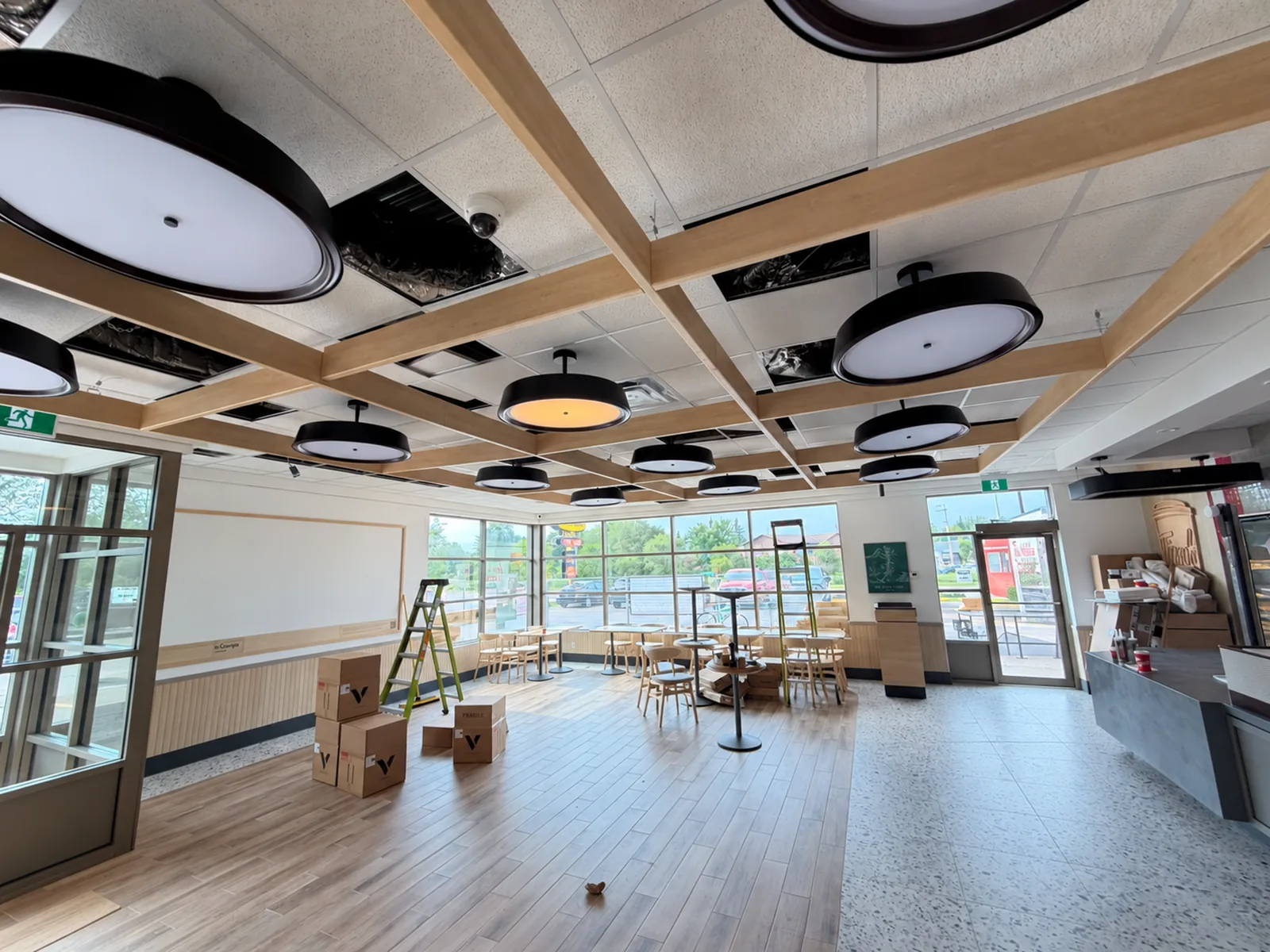
On site, the two scopes meet at the same ceilings, walls and panels. A few habits keep them from colliding:
Walk the space with the schedule in hand
Check each landlord's work item against what is actually there before you accept possession.
Photograph and record the starting condition
This becomes your baseline for deficiencies now and restoration later.
Coordinate tie-ins early
Sprinkler, fire alarm and HVAC connections to base-building systems often need the landlord's trades or approval.
Keep one schedule
Landlord's work and tenant's work should share a single timeline so trades are not waiting on each other.
Close out with paperwork
Invoices, approvals and inspection records support your allowance claim.
XBuilt builds tenant improvements and retail fit-outs across the GTA, with permit and inspection coordination and hands-on site supervision. If you are still choosing a space, read our construction checklist for commercial leases or request a quote to have us walk the unit.
This article is general information, not legal advice. Every lease splits the work differently, so have a lawyer review your offer to lease and lease, including the work schedules, before you sign.
FAQ
Landlord's work and tenant's work FAQ
What is the difference between landlord's work and tenant's work?
Landlord's work is the list of items the landlord must complete at its own cost, usually before or shortly after the lease commencement date. Tenant's work is everything else needed to make the space ready for the tenant's business, done at the tenant's cost and usually subject to the landlord's approval of drawings.
Is the landlord responsible for HVAC in a commercial lease?
It depends on the lease. Landlords often supply a base unit or supply air to the premises, while distribution and extra capacity are tenant's work. If the space is offered as is, inspect the HVAC and other building systems before you sign and agree in writing who repairs or replaces them.
What happens if the landlord's work is late?
If the fixturing period has already started, the tenant loses construction time. Tenants can ask for the fixturing period to start only when landlord's work is actually complete, and a lawyer should review how delays are handled in the lease.
Sources
- Thompson Dorfman Sweatman LLP — Offers to lease
- Pacific Legal PC (via Mondaq) — Renting a commercial property in Ontario (2025)
- Anton M. Katz, Barrister and Solicitor — Conduct due diligence, negotiate before signing a commercial lease
- McMillan LLP (via Mondaq) — The cost of leaving: restoring premises at the end of a commercial lease (2026)
- Minden Gross LLP — Tenant negotiating 101: a simple guide to the commercial lease
- Bennett Jones — Ontario landlords may now have lien claim exposure from tenant's work
- Gowling WLG — 5 things commercial landlords should know about the new Construction Act
- City of Toronto — Interior alterations (non-residential) permit guide