Key takeaways
- A multi-location rollout works best when a prototype, a standard scope and one contracting model are agreed before the first store starts.
- CCDC offers stipulated price (CCDC 2), cost plus (CCDC 3), unit price (CCDC 4) and construction management (CCDC 5A/5B) contracts; each suits a different kind of program.
- The Ontario Building Code applies province-wide, but each municipality runs its own permit office. In Toronto, eligible small commercial interior alterations target a 3-business-day review.
- Some paperwork repeats at every site: Notices of Project above $50,000, WSIB clearances every 90 days, and prompt payment and holdback rules on every invoice.
01 — The idea
What a multi-location rollout program is
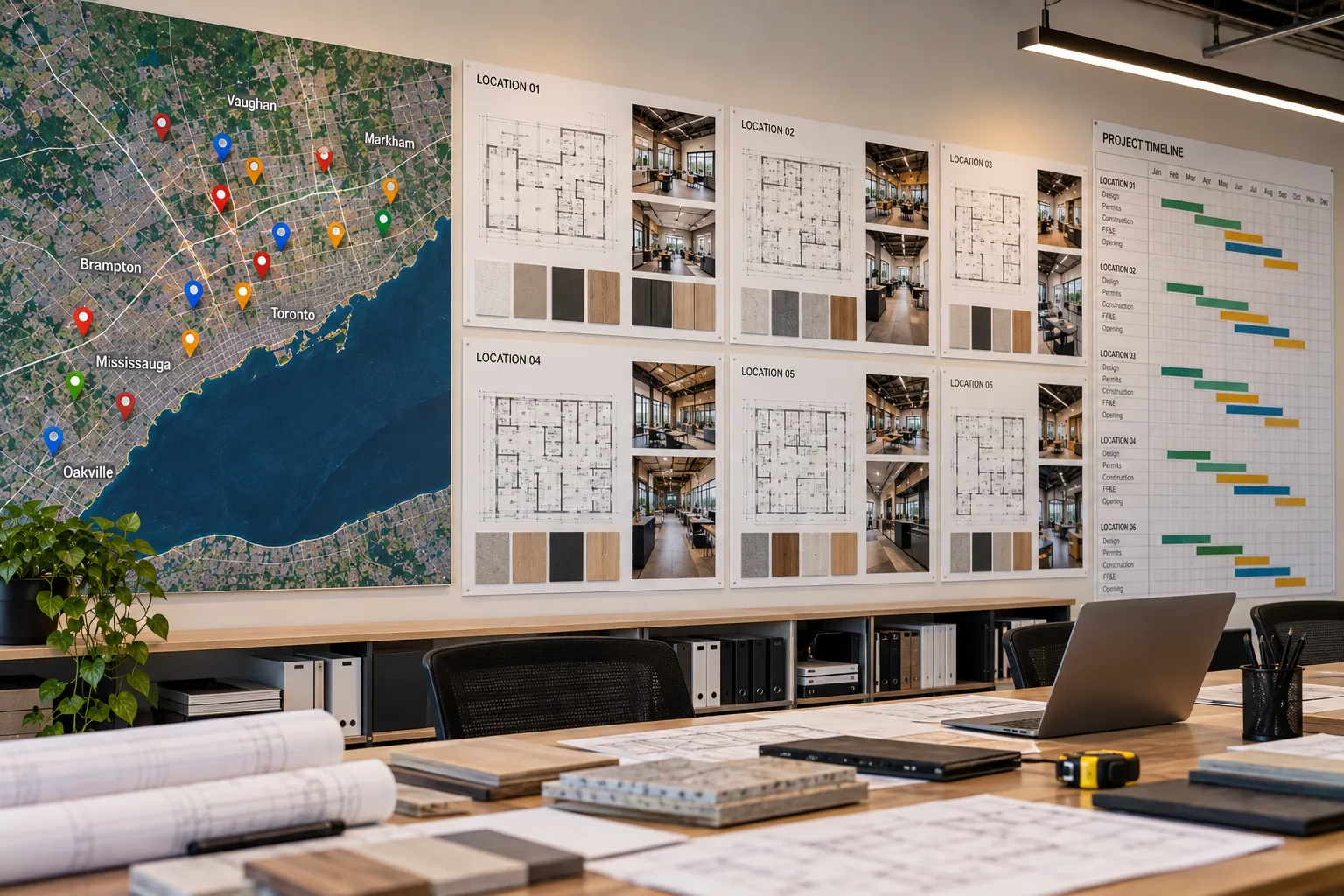
A multi-location rollout is a planned series of new stores, remodels or refreshes built to the same brand standard, usually by the same team, over months or years. Franchise systems use them to roll out a new design; retailers use them to open in new markets; landlords and operators use them to update a portfolio.
The value of treating the work as a program, rather than a string of one-off jobs, is repetition. The fifth store should be faster and cleaner than the first because the drawings, the specifications, the suppliers and the punch list have already been tested. That only happens if somebody captures what was learned and feeds it back into the next location. If you run quick-service locations, our QSR remodel checklist covers the store-level detail; this article covers the program.
Set the foundations first
- A prototype. One approved set of drawings and finishes, with clear rules on what can be adapted to each site.
- A standard scope. A written list of what is included at every store, so every bid prices the same thing.
- Long-lead items. Millwork, signage, lighting and equipment ordered on a program schedule, not store by store.
- One point of contact. A program manager on the owner's side and one on the contractor's side.
- A lessons-learned log. Deficiencies and design questions recorded after each turnover and closed before the next drawing set is issued.
02 — Contracts
Choosing a contract model for a multi-location rollout
Most Canadian commercial work is contracted on standard forms published by the Canadian Construction Documents Committee (CCDC). The family includes four pricing approaches that are all used for rollouts. The right one depends on how well the scope is defined and how much price certainty you need per store.
| Model | CCDC form | How the price works | Fits a program when… |
|---|---|---|---|
| Stipulated price | CCDC 2 | A fixed price for a defined scope at each location. | Drawings are complete and every store is bid separately. |
| Unit price | CCDC 4 | Agreed rates per unit of work, multiplied by measured quantities. | The work repeats in measurable units, such as fixtures, flooring or ceiling area. |
| Cost plus | CCDC 3 | Actual cost of the work plus an agreed fee. | Existing conditions are uncertain, such as remodels of older stores. |
| Construction management | CCDC 5A / 5B | A construction manager is paid for services (5A), or for services and construction (5B). | The owner wants a manager involved early across a large program. |
Many programs use a master agreement that fixes the general terms once, then issue a short work order or stipulated price for each location. Whatever model you choose, make sure the contract is clear on which version of the prototype applies, who carries the long-lead orders, and how unit rates are adjusted if the program runs over several years.
This is general information, not legal advice. Have your lawyer review any master agreement before signing.
03 — Approvals
Permits: one Building Code, many building departments
The Ontario Building Code applies across the province, so a prototype designed for one Ontario city will meet the same technical rules in another. What changes is the permit office. Each municipality has its own forms, zoning review and service levels, and that is where rollout schedules slip. Toronto publishes target review times for complete applications:
| Stream | Typical rollout scope | Target review |
|---|---|---|
| Express Service, small commercial | Interior alterations to business, office, retail and restaurants under 30 seats up to 600 m², or assembly and industrial up to 300 m², with no change of use or patron area | 3 business days |
| Small Building Stream | Buildings within Part 9 of the Building Code | 15 business days |
| Large & Complex Stream, large buildings | Buildings within Part 3 of the Building Code | 20 business days |
| Large & Complex Stream, complex buildings | Part 3 buildings the City classifies as complex | 30 business days |
One detail matters for every Toronto store: an application is only complete with an issued Zoning Applicable Law Certificate (ZAP). Without it, no review clock applies. Build the zoning step into each location's schedule, and check the equivalent process in Mississauga, Brampton, Vaughan or Ottawa rather than assuming it works the same way.
Requirements change. Confirm with each municipality before you apply.
04 — Schedule
The rollout cycle, location by location
Every store in a program moves through the same six phases. The difference between a smooth program and a stressful one is how far ahead of construction the early phases run.
In a well-run program, phases 1 to 3 for the next store overlap with phase 5 at the current one. When stores stay open during remodels, construction is often split into night or weekend shifts; XBuilt schedules site work outside regular hours when the client, landlord or site requires it.
05 — Compliance
Paperwork that repeats at every site
Some obligations attach to each project, not to the program as a whole. Build them into the location checklist so nothing depends on memory:
- Notice of Project. In Ontario, the constructor must notify the Ministry of Labour before construction begins when the total cost of labour and materials is expected to exceed $50,000.
- WSIB clearance. A clearance is valid for up to 90 days across all of a contractor's contracts, so a long program needs renewed clearances, not one at the start.
- Prompt payment. Under Ontario's Construction Act, the owner pays a proper invoice within 28 days, and the contractor pays its subcontractors within 7 days after receiving payment. If the contract is silent, invoices are monthly.
- Holdback. Owners retain a 10% holdback. For contracts entered into on or after January 1, 2026, accrued holdback must be released every year on the contract anniversary, which matters for multi-year master agreements.
- Landlord requirements. Mall and plaza landlords often have their own insurance certificates, work hours and approval steps for each unit.
Our guide to holdbacks and prompt payment in Ontario explains the payment rules in more detail.
06 — Control
Measuring the program
A rollout gives you something a single project never does: a baseline. Track the same few measures at every location and review them before the next drawing set goes out.
Measure at every store
Same yardstick- Final cost compared with the prototype budget
- Permit time compared with the municipality's target
- Construction days from mobilization to turnover
- Deficiencies open at turnover and days to close them
Feed back into the program
Next store- Update the prototype drawings and specifications
- Adjust lead times for repeat items
- Revise the standard scope and exclusions
- Share recurring issues with designers and suppliers
XBuilt builds multi-location rollouts for restaurant, QSR and retail brands across Toronto, Mississauga, Brampton, Vaughan, Whitby, Barrie, Kingston, Ottawa and the rest of Ontario, with the same management team from estimate to turnover. See our restaurant and QSR construction and retail fit-out pages for the store-level scope, or request a quote for your program.
07 — FAQ
Rollout program FAQ
What is a multi-location rollout?
A multi-location rollout is a planned series of new stores, remodels or refreshes built to the same brand standard over a set period, usually managed as one program with a prototype design, a standard scope and the same contractor or contracting model across locations.
Which contract works best for a store rollout program?
It depends on how defined the scope is. A stipulated price contract (CCDC 2) suits complete drawings bid store by store, a unit price contract (CCDC 4) suits repeating measurable work, cost plus (CCDC 3) suits uncertain remodels, and construction management (CCDC 5A or 5B) suits large programs where the owner wants a manager involved early.
Do permit rules change from city to city in Ontario?
The Ontario Building Code is the same across the province, but each municipality runs its own permit office, zoning review and service levels. In Toronto, eligible small commercial interior alterations can use Express Service, which targets a review within 3 business days of intake.
Sources
- MLT Aikins — The interplay between CCDC documents and other construction documents (2024)
- Langlois Lawyers — Dawn of the 'super contract' (CCDC contract types, 2018)
- City of Toronto — Building permit review streams
- Government of Ontario — File a work notice (Notice of Project)
- WSIB — Clearances
- McCarthy Tétrault — A primer on the amendments to Ontario's Construction Act (prompt payment)
- Robins Appleby LLP via Mondaq — Two key changes to Ontario's Construction Act, Bill 216 and Bill 60 (2026)