Key takeaways
- Toronto's Sewers By-law (Chapter 681) requires food service establishments to install, operate and maintain a grease interceptor, with fines of up to $100,000 for a business.
- Dish sinks, self-cleaning hood drains and cooking equipment drains must connect. Toilets, urinals and hand sinks must not.
- A building permit is required to install or replace an interceptor, and the City can require a new one after an expansion or a new business moves in.
- Hydromechanical units are serviced every four weeks or before grease and solids reach 25% of liquid volume, whichever comes first. Keep records for seven years.
01 — The rule
What Toronto's Sewers By-law requires
If you run a restaurant, café, bakery or any food service business, a grease interceptor in Toronto is not optional. Under the City's Sewers By-law (Municipal Code Chapter 681, section 681-10), food-related establishments must take all necessary measures to keep oil and grease out of the municipal sewer connection, and must install a grease interceptor in compliance with the Building Code and maintain it under the City's Food Service Establishment Environmental Code of Practice.
The rule covers restaurants, coffee shops, banquet halls, bakeries, delis, grocery stores with a food counter, butcher shops, food trucks and institutional kitchens. The stakes are real:
- Violations can lead to fines of up to $75,000 for an individual and $100,000 for a business.
- If your premises causes a sewer blockage, the City may bill you for the repair.
- The by-law's sanitary sewer limit for animal and vegetable oil and grease is 150 mg/L (15 mg/L for mineral and synthetic oil and grease).
- The City may inspect, examine your records and take wastewater samples.
02 — Equipment
Types of grease interceptors
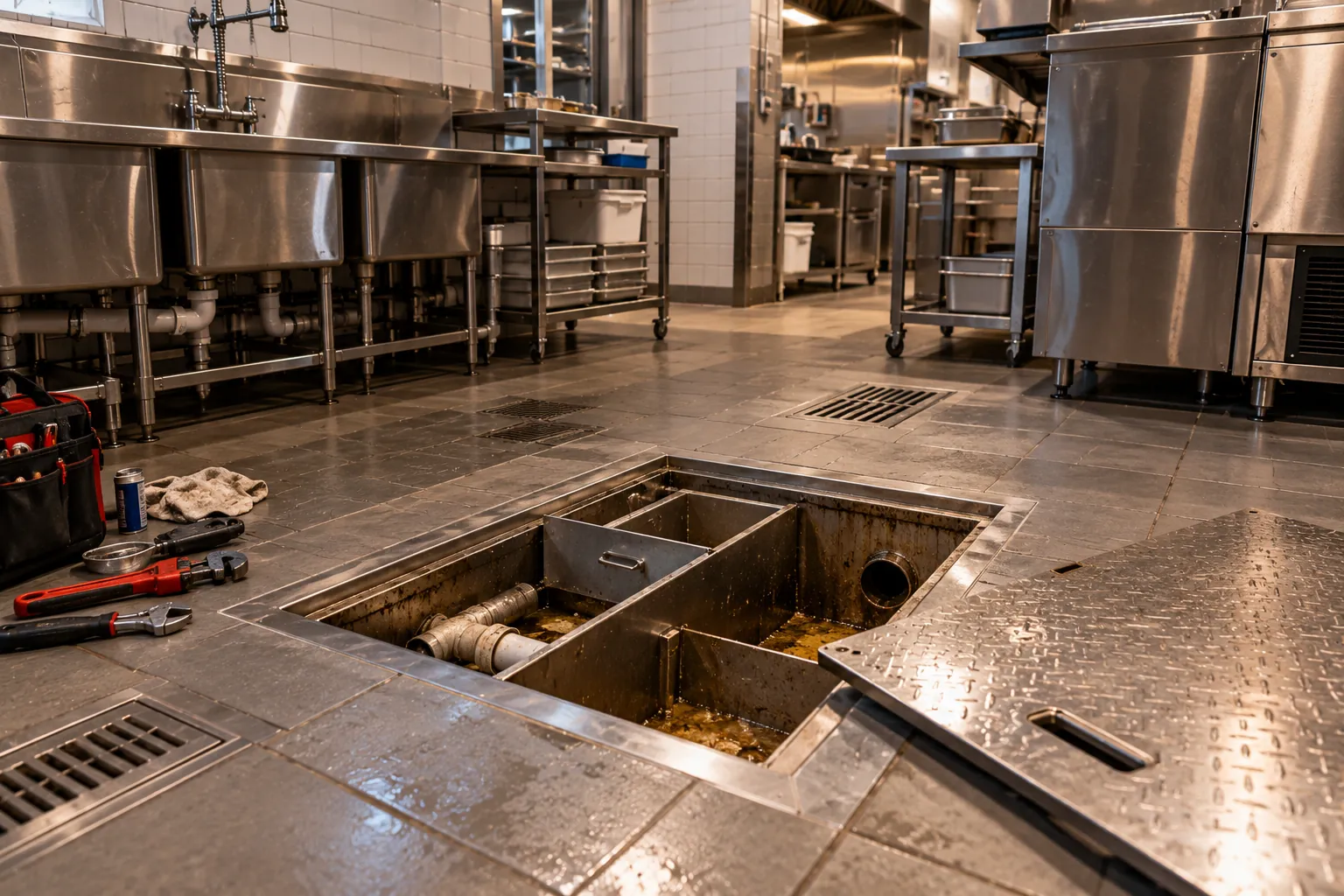
Toronto's Code of Practice describes two main types. Which one you need depends on the size of your kitchen, the volume of fats, oils and grease you produce, and the Ontario Building Code sizing your plumbing designer applies.
Hydromechanical (point-of-source)
At the fixture- Installed at or near the sink or fixture
- Must meet CSA B481.1:22, as required by the Building Code
- Serviced every four weeks or at 25% capacity
- Labelled with flow rating and capacity
Gravity interceptor
300 – 2,000 gal- Used in large kitchens and industrial premises
- No CSA standard; sized as required by the Building Code
- Pumped out before grease and solids reach 25%
- Size range as described by the City
The City also refers to solids interceptors, which must be emptied daily, and grease recovery devices, which follow the manufacturer's frequency with daily removal of solids and liquids and daily logs.
03 — Plumbing
Which fixtures must connect to the interceptor
Getting the connections right is a design decision, and it is much cheaper on paper than after the slab is closed. The City's installation rules sort fixtures into three groups.
| Rule | Fixtures | Note |
|---|---|---|
| Must connect | Pot, pan, dish and utensil sinks; drains for self-cleaning exhaust hoods; drains for commercial cooking equipment | Required in every food service establishment |
| May need to connect | Floor drains, mop sinks, garbage disposal drains, dishwashers, food-waste compactor drains | Required if they carry fats, oils or grease. A pre-rinse sink connected to the interceptor can serve the dishwasher instead |
| Must not connect | Toilets, urinals, hand sinks, food grinders and peelers | Grinders and peelers only through a solids interceptor first |
Hand sinks are a common trap. Toronto Public Health requires a separate hand-washing sink in every food preparation area, and those sinks must stay off the interceptor. On a new layout, your designer and contractor should mark every drain's destination on the plumbing drawings.
04 — Installation
Installation and permits
- Permit. A building permit is required to install or replace a grease interceptor, and the work must follow the Ontario Building Code.
- Location. The interceptor must be easy to reach for maintenance and inspection. Under a cook line or behind fixed millwork is a poor choice.
- Labels. Compliant units show flow rating, removal efficiency, maximum capacity and inlet size, and the inlet and outlet must be labelled with flow direction. If the markings are hidden after installation, keep the manufacturer and installation drawings on site.
- Change of operations. The City may require a replacement or new interceptor if the existing one harms the sewer system, or after a significant change in operations such as an expansion, a new business or a new building.
That last point matters when you lease a former restaurant. An existing interceptor may be reusable, but it is worth confirming its size, condition and records before you sign. Our checklist for second-generation restaurant space covers the other systems to check at the same time.
05 — Operations
Cleaning schedule and record keeping
| Device | Servicing frequency |
|---|---|
| Hydromechanical interceptor (grease trap) | Every four weeks, or before grease and solids reach 25% of liquid volume, or before rated capacity is exceeded, whichever comes first. Up to eight weeks may be allowed if records show levels stay under 25% at four weeks. |
| Gravity interceptor | Pumped out before fats, oil, grease and solids exceed 25% of liquid volume |
| Solids interceptor | Same schedule as the grease interceptor, with the strainer and vessel emptied daily |
| Grease recovery device | Manufacturer's frequency, with solids and liquids removed daily and daily logs |
Who can service it
An establishment may service its own interceptor only if it generates a low volume of fats, oils and grease and has no stove or fryer. Everyone else needs a waste carrier approved by the Ontario Ministry of the Environment, Conservation and Parks. Self-serviced units need weekly surface skimming and a monthly vacuum and full clean, with logs kept on site.
What not to do
The City prohibits chemicals or other agents that help grease pass through the interceptor, including bleach, enzymes, bacteria, solvents and hot water. They only break grease down temporarily, and it can re-harden further down the line.
Records
Keep all servicing and disposal records on site for at least seven years. Service receipts should show the date and time, work performed, estimated grease and solids level, service frequency, interceptor condition and disposal location. Disposal records need the company name, date, waste type and measured quantity.
06 — Planning
Planning the interceptor into your build-out
On a new restaurant, the interceptor belongs in the first plumbing layout, alongside the hood and the cook line. Public 2026 data for Toronto puts restaurant plumbing at $25 to $50 per square foot, covering multiple sinks, dishwashing stations and grease trap installation (CHI Real Estate). Where the interceptor sits, and whether the slab has to be cut to reach the sanitary line, affects where a project lands in that range.
Market range from a public 2026 source for the Toronto area, shown to help you plan. It is not an XBuilt quote. Every project is priced after a site visit and a review of your drawings.
XBuilt coordinates plumbing, permits and inspections as part of every restaurant fit-out, and the timing of each step is laid out in our restaurant build-out timeline. For remodels of operating stores, see our commercial renovations service. Planning a new kitchen or an interceptor replacement? Request a quote.
FAQ
Grease interceptor FAQ
Do I need a grease interceptor for my restaurant in Toronto?
Yes. Toronto's Sewers By-law requires food service establishments, including restaurants, coffee shops, bakeries, delis, grocery stores with a food counter and food trucks, to install, operate and maintain a grease interceptor. Fines can reach $100,000 for a business.
How often does a grease trap need to be cleaned in Toronto?
A hydromechanical grease interceptor must be serviced every four weeks, or before grease and solids reach 25 per cent of its liquid volume, whichever comes first. The City may allow up to eight weeks if records show levels stay under 25 per cent.
Do I need a permit to install a grease interceptor in Toronto?
Yes. The City of Toronto requires a building permit to install or replace a grease interceptor, and the installation must follow the Ontario Building Code.
Sources
- City of Toronto — Mandatory grease interceptors for food service establishments (2026)
- City of Toronto — Food Service Establishment Environmental Code of Practice
- City of Toronto — Grease interceptor installation
- City of Toronto — Grease interceptor maintenance
- City of Toronto — Municipal Code Chapter 681, Sewers
- City of Toronto — Structural requirements for food premises
- CHI Real Estate — Startup costs for opening a restaurant in Toronto (2026)