Key takeaways
- Price both options, phased work while open and a short full closure, before you decide.
- Toronto allows clearly audible construction noise 7 a.m. to 7 p.m. on weekdays and 9 a.m. to 7 p.m. on Saturdays; night work may need an exemption permit.
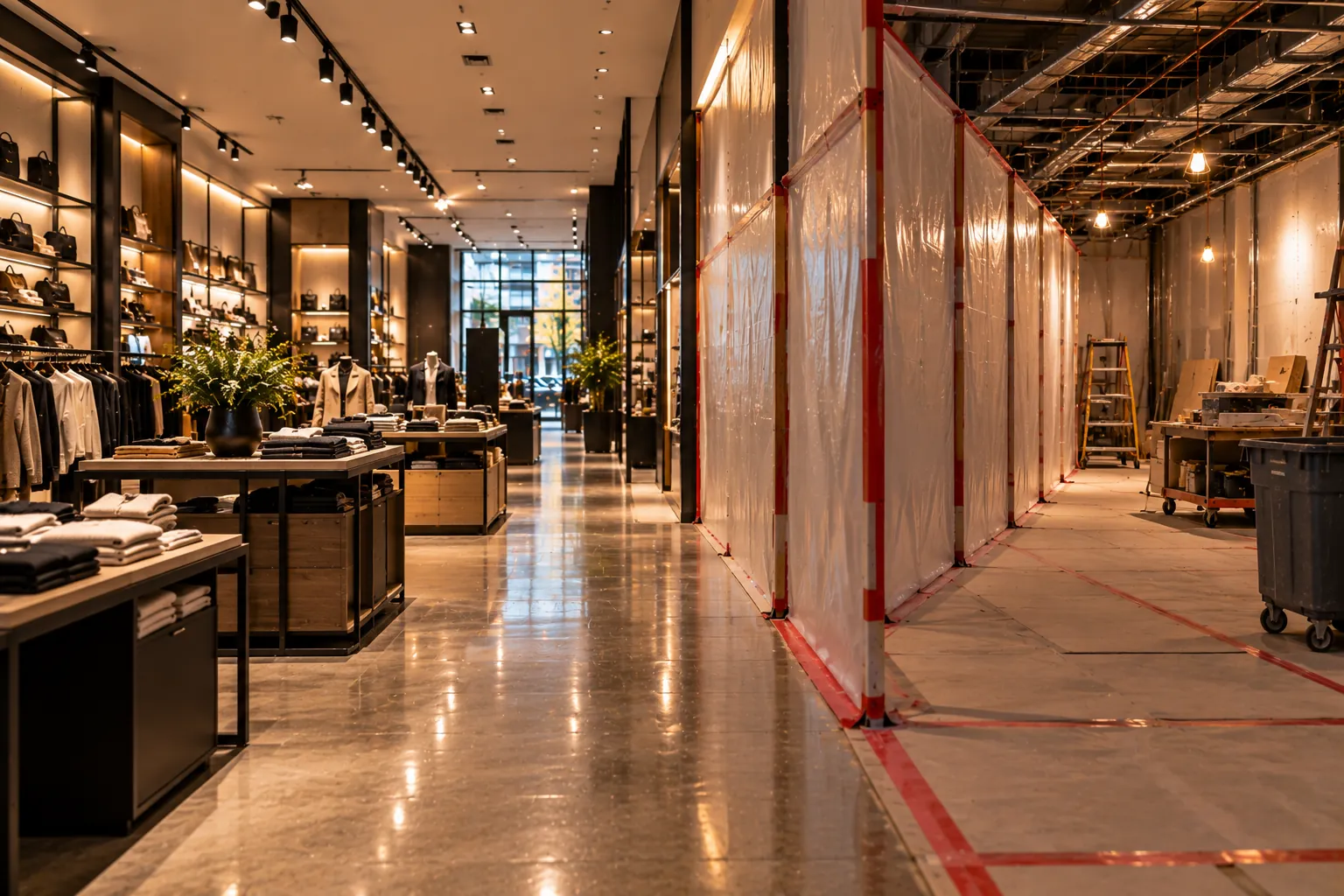
- Full-height hoarding, low-VOC products and fire-safety notices keep customers safe in a working store.
- Staying open doesn't change permit requirements; eligible retail alterations can use Toronto's 3-business-day Express Service.
01 — The decision
Can you renovate a store while open?
For most retail refreshes, yes. You can renovate a store while open if the work is split into zones, each zone is fully closed off, and the noisy, dusty and odour-producing tasks happen when customers are gone. The cost is a longer schedule and more coordination; the payoff is that the till keeps ringing.
Work that splits easily into zones suits phasing best: lighting, paint, fixtures, millwork, fitting rooms and ceilings done one bay at a time. Work that touches the whole store at once is harder. Replacing the entire sales floor, rerouting main ductwork or rebuilding the only washroom can still be done while open, but it takes more nights, more temporary measures and more planning.
The choice is not always obvious. Before you commit, ask your contractor to price both options: phased work while open, and a short full closure. Then compare the construction difference with what the store earns in those weeks.
Phased renovation while open
Keep trading- Revenue continues through most of the project
- Work zones hoarded off from customers
- Noisy work moved outside store hours
- Longer overall schedule and more site coordination
Short full closure
Faster build- Crews work freely during the day
- Simpler sequencing for floors and ceilings
- No customer protection to maintain
- Lost sales for every closed day
02 — Phasing
Build a phasing plan before you build anything
A phasing plan divides the store into zones and decides the order. A typical sequence moves from the back of the store to the front, so the sales floor and entrance stay open as long as possible:
Each zone needs a clear start and finish, a route for customers that avoids it, and a plan for where merchandise and fixtures go while it is closed. Keep exits, fire routes and accessible paths open in every phase, and have your designer confirm any temporary change. Washrooms deserve special attention; if yours are being rebuilt, see our accessibility and washroom upgrades page.
03 — Working hours
When the noisy work can happen
Working at night solves one problem and creates another. Toronto's Noise Bylaw (Chapter 591) limits clearly audible construction noise, and a street-front store with apartments above or behind it has neighbours who will notice. The City's rules:
| Item | Rule |
|---|---|
| Weekdays | Audible construction noise allowed 7 a.m. – 7 p.m. |
| Saturdays | Allowed 9 a.m. – 7 p.m. |
| Sundays and statutory holidays | Not allowed |
| Fine for noise outside permitted hours | $900 |
| Noise exemption permit fee | $118.98 (Level 1) · $367.74 (Level 2) · $616.51 (Level 3) |
| Late application fee | $91.94 |
| Lead time | Apply 28 days before the work; most applications take three to four weeks |
| Neighbour notice | Residents within 120 metres, at least seven days before |
Fees exclude any City noise monitoring charges. Rules change; confirm with the City of Toronto before you schedule night work.
The bylaw's test is whether the noise is clearly audible. Quiet tasks such as painting, finishing or fixture assembly may fit inside a closed store at night; demolition, coring and grinding are the ones to plan around. For Level 1 and 2 permits, the local councillor is notified and the permit is approved if there is no objection within 14 days; Level 3 needs the councillor's explicit no-objection.
Inside a mall
Mall and concourse landlords usually push work the other way, after closing. One published Toronto manual (2025) keeps tenant work outside 7:30 a.m. to 6:30 p.m. on weekdays and 9:00 a.m. to 5:00 p.m. on Saturday, and makes hammer drilling an after-hours task. Our guide to mall tenant criteria covers the rest of those rules.
04 — Safety
Keep customers safe and the store clean
When customers share the building with a construction site, the work zone has to be separated properly. The 2025 landlord manual above is a good benchmark even for street-front stores:
- Full-height drywall hoarding, taped, sanded and painted, wherever work faces the public
- Low-odour, low-VOC paints and sealers only, with strong-smelling work kept after hours
- 48 hours' written notice before welding, grinding, sanding or core drilling, so smoke detection can be managed
- 72 hours' notice for sprinkler shutdowns, and a one-hour watch after welding or open-flame work
Add a daily routine of your own: every walkway cleaned and checked before the store opens. Paperwork applies too. When labour and materials are expected to exceed $50,000, the constructor must file a Notice of Project with Ontario's Ministry of Labour before work begins and keep a signed copy on site.
05 — Permits
Staying open doesn't change the permit
A phased renovation needs the same permits as any other. In Toronto, interior alterations to retail, office and business uses up to 600 m², with no change in use, can go through Express Service, which aims to review eligible applications within 3 business days. Larger or more complex work uses the regular streams, with 15 to 30 business day targets for complete applications. Our step-by-step guide to commercial building permits in Toronto explains the process.
06 — Communication
Tell staff, customers and neighbours what's coming
A renovation while open is as much a communication job as a construction job. Share the phasing plan with store managers so they can staff and merchandise around it, put up clear signs for customers, give the landlord or property manager the schedule and notices they require, and keep neighbours informed when night work is planned.
XBuilt manages commercial renovations and retail fit-outs across Toronto and Ontario, and schedules site work outside regular hours when the store or the site requires it. If you are weighing a phased renovation against a short closure, request a quote and we will price both.
FAQ
Renovating while open FAQ
Can a store stay open during a renovation?
In most cases, yes, if the work is phased, each work zone is fully hoarded, and noisy or odour-producing tasks are scheduled when customers are not in the store. For heavy work across the whole sales floor, a short full closure may be faster, so it is worth pricing both.
What hours can construction happen in Toronto?
Toronto's Noise Bylaw allows clearly audible construction noise from 7 a.m. to 7 p.m. on weekdays and 9 a.m. to 7 p.m. on Saturdays, and not on Sundays or statutory holidays. Work outside those hours that would be clearly audible needs a noise exemption permit.
Do I need a permit to renovate a store while it is open?
Staying open does not change permit requirements. Most interior alterations need a building permit; in Toronto, retail interior alterations up to 600 square metres with no change in use can qualify for Express Service, which aims to review eligible applications within 3 business days.
Sources
- City of Toronto — Noise (Noise Bylaw, Chapter 591) (2026)
- City of Toronto — Noise exemption permit (2026)
- City of Toronto — Building permit review streams (2026)
- Government of Ontario — File a work notice (Notice of Project) (2026)
- First Canadian Place — Tenant Design & Construction Manual, TDCM100.11 (April 2025)