Key takeaways
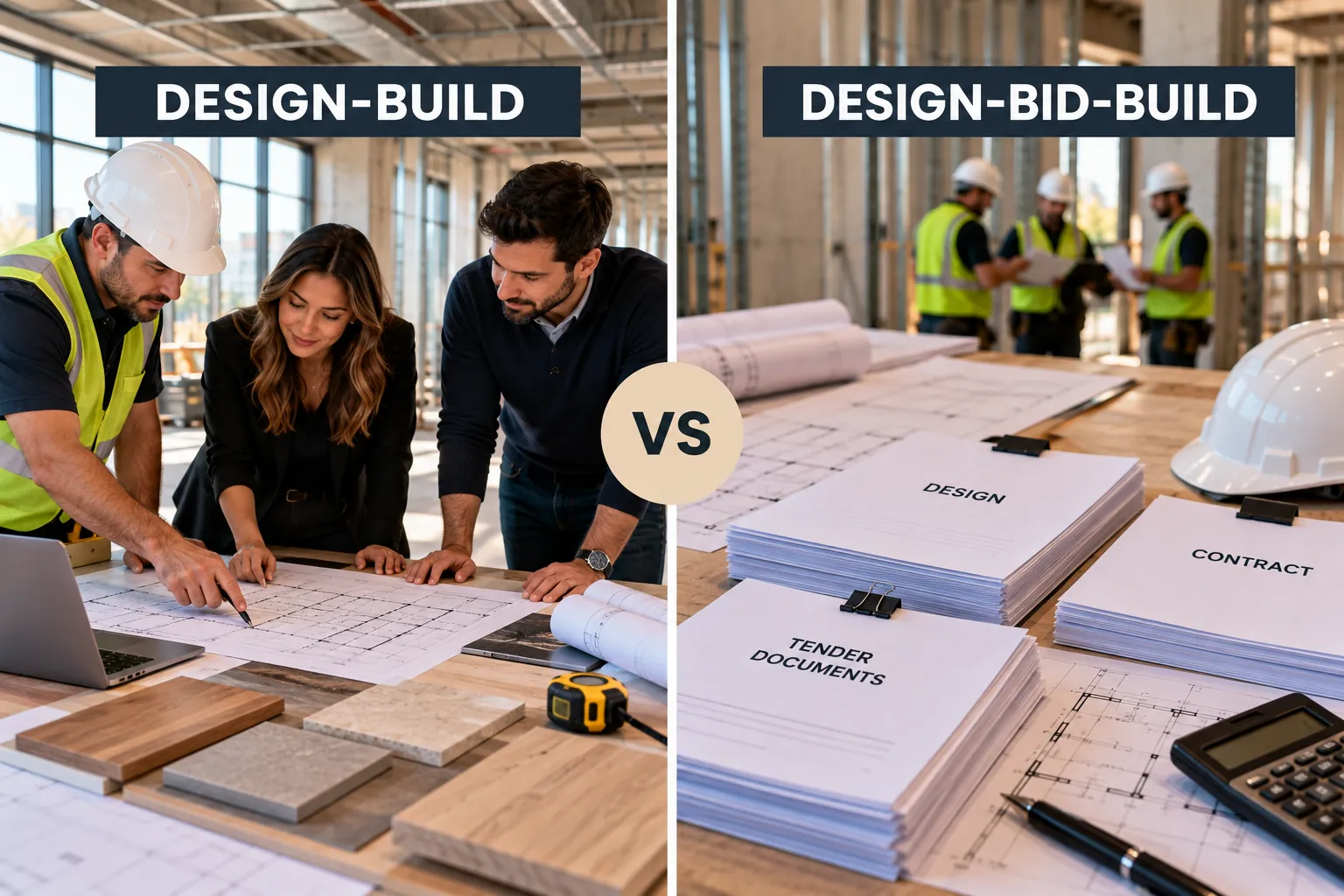
- In design-bid-build, the owner hires a designer, completes the drawings, then tenders them to contractors, usually on a CCDC 2 stipulated price contract.
- In design-build, one firm is responsible for both design and construction, under the CCDC 14 design-build stipulated price contract.
- CCDC released updated design-build documents in 2026, including a first edition of a progressive design-build contract (CCDC 32).
- Design-build suits tight schedules and repeat prototypes; design-bid-build suits owners who want full control of the design and a competitive tender.
01 — The basics
Two ways to deliver a commercial project
The design-build vs. design-bid-build question is really about how many contracts you sign and in what order.
Design-bid-build
This is the traditional route. The owner works with an architect to design the project, then hires a general contractor to build it. The contractor hires the trades, buys materials, runs the site and is paid by the owner. In Canada this is usually done on CCDC 2, the stipulated price contract: the drawings are tendered, contractors bid a fixed price, and the owner signs with the chosen bidder. The owner holds two separate contracts, one with the designer and one with the builder.
Design-build
Here the owner signs one contract with a design-builder, who is responsible for both the design and the construction, based on the owner's requirements. The standard Canadian form is CCDC 14, the design-build stipulated price contract, with CCDC 15 as the contract between the design-builder and its consultant. Because one firm owns both sides, design and early construction work can overlap.
A newer variation, progressive design-build, develops the design with the owner in stages, or "gates", and fixes the construction price only once the design is far enough along.
02 — Comparison
Design-build vs. design-bid-build, side by side
| Factor | Design-bid-build | Design-build |
|---|---|---|
| Contracts the owner signs | Two: designer and contractor | One: the design-builder |
| Who is responsible for the design | The owner's architect and engineers | The design-builder |
| When the price is fixed | At tender, on completed drawings | At contract, on the owner's requirements |
| Schedule | Design, then tender, then build, in sequence | Design and construction can overlap |
| Owner's control of design details | High: drawings are finished before pricing | Lower: set through the statement of requirements |
| Disputes over drawing errors | Can fall between designer and contractor | One firm answers for both |
| Standard CCDC form | CCDC 2 (stipulated price) | CCDC 14, or CCDC 32 for progressive design-build |
Design-build
Speed and one point of contact- Single contract and single point of responsibility
- Design and early works can overlap
- Builder's cost knowledge shapes the design early
- Requires a clear statement of what you need
Design-bid-build
Control and competition- Owner controls every design decision
- Contractors bid on the same complete drawings
- Longer sequence: design, tender, then build
- Drawing gaps can turn into change orders
03 — Contracts
The CCDC contracts behind each model
The Canadian Construction Documents Committee publishes the standard forms most Canadian commercial projects use. Picking the delivery model largely picks the contract.
| Document | Name | Used for |
|---|---|---|
| CCDC 2 | Stipulated Price Contract | Design-bid-build with a fixed price |
| CCDC 3 | Cost Plus Contract | Owner-designed work paid at cost plus a fee |
| CCDC 4 | Unit Price Contract | Owner-designed work paid by measured units |
| CCDC 5A / 5B | Construction Management Contracts | A construction manager for services only (5A), or for services and construction (5B) |
| CCDC 14 | Design-Build Stipulated Price Contract | Design-build with a fixed price |
| CCDC 32 | Progressive Design-Build Contract | Design developed in gates; construction price set by a final proposal |
What changed in the 2026 editions
In 2026 CCDC released updated editions of CCDC 14 and CCDC 15, the first design-build updates since 2013, and first editions of CCDC 32 and CCDC 33 for progressive design-build. According to Osler, the new documents respond to Ontario's prompt payment and adjudication rules, higher insurance amounts and early occupancy. They also introduce a "ready-for-takeover" milestone that largely replaces substantial performance for warranty and claims purposes, while lien holdback stays tied to substantial performance. For progressive design-build, the authors suggest owners consider a guaranteed maximum price in the supplementary conditions, because the total cost is not known until late in the process. The 2013 editions remain available.
General information, not legal advice. Have a construction lawyer review the contract form and supplementary conditions for your project.
04 — Ontario
Ontario rules that apply either way
Choosing design-build does not remove any approval step. The same rules apply under both models:
- Licensed designers. Ontario's Architects Act requires an architect for most public-use and large buildings. In design-build, the design-builder engages those professionals; it does not replace them.
- Permits. Drawings still go through the municipal permit process. In Toronto, eligible small commercial interior alterations can use Express Service, which targets a 3-business-day review; Part 3 buildings target 20 business days, or 30 for complex buildings.
- Payment rules. The 10% holdback, 28-day prompt payment and annual holdback release apply to both. See our guide to holdbacks and prompt payment in Ontario.
- Insurance. In design-build, ask how the design side is insured, since the design-builder answers for the drawings. Our article on contractor insurance in Ontario covers the main policies.
05 — Decision
Which delivery model fits your project?
Lean towards design-build when
- Your lease or opening date leaves little room for a separate design and tender phase.
- You are building a repeat prototype, as in a multi-location rollout, and the design questions are already answered.
- You want one firm accountable for the drawings, the budget and the build.
Lean towards design-bid-build when
- You want to control every design decision before you commit to a price.
- Your procurement rules require a competitive tender on complete drawings.
- Your landlord or brand already supplies a full drawing set.
XBuilt works both ways. We build to your architect's drawings as general contractor, and we coordinate design-build projects with our network of design partners, covering architectural and engineering coordination, permits and inspections. See our commercial construction and commercial renovation services, read how to choose a commercial general contractor in Toronto, or request a quote and tell us which model you are considering.
06 — FAQ
Design-build vs. design-bid-build FAQ
What is the difference between design-build and design-bid-build?
In design-bid-build, the owner hires a designer to complete the drawings, then tenders them and signs a separate contract with a general contractor, usually on CCDC 2. In design-build, the owner signs one contract with a design-builder that is responsible for both design and construction, usually on CCDC 14.
Is design-build faster than design-bid-build?
It can be, because design and early construction work can overlap and there is no separate tender after the design is finished. Permits, inspections and long-lead items still take the same time under either model.
What is progressive design-build?
Progressive design-build develops the design with the owner in stages, or gates, and sets a stipulated price for construction only in a final proposal. CCDC published its first progressive design-build contract, CCDC 32, in 2026.
Sources
- Osler — CCDC releases 2026 documents for design-build and progressive design-build contracting (2026)
- MLT Aikins — The interplay between CCDC documents and other construction documents (2024)
- Langlois Lawyers — Dawn of the 'super contract' (CCDC contract types, 2018)
- Ontario Bar Association — Compare and contract: CCDC 2 and CCDC 5A (2023)
- Ontario Association of Architects — When do you need an architect?
- City of Toronto — Building permit review streams