Key takeaways
- Landlords control much of a food court unit: the floor in front of the counter, make-up air, sprinkler and fire alarm contractors, and hoarding.
- Published Toronto criteria give the landlord 10 business days for each of two design reviews, before or alongside the building permit.
- Noisy work usually happens after mall hours, but Toronto's Noise Bylaw limits clearly audible construction noise at night.
- Closeout documents are due within 60 days in some manuals, or the construction deposit is forfeited.
01 — The unit
Why food court restaurant construction is different
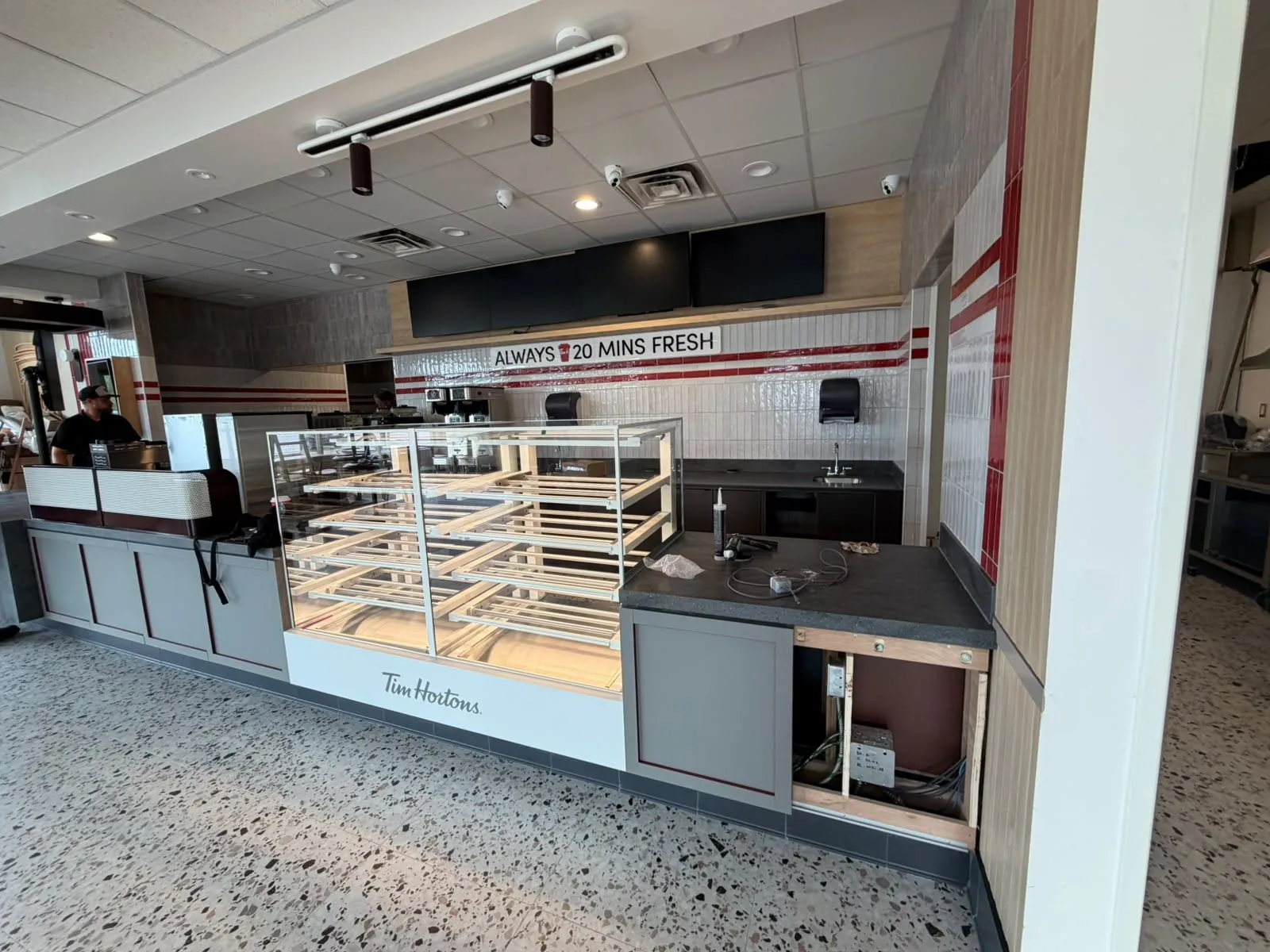
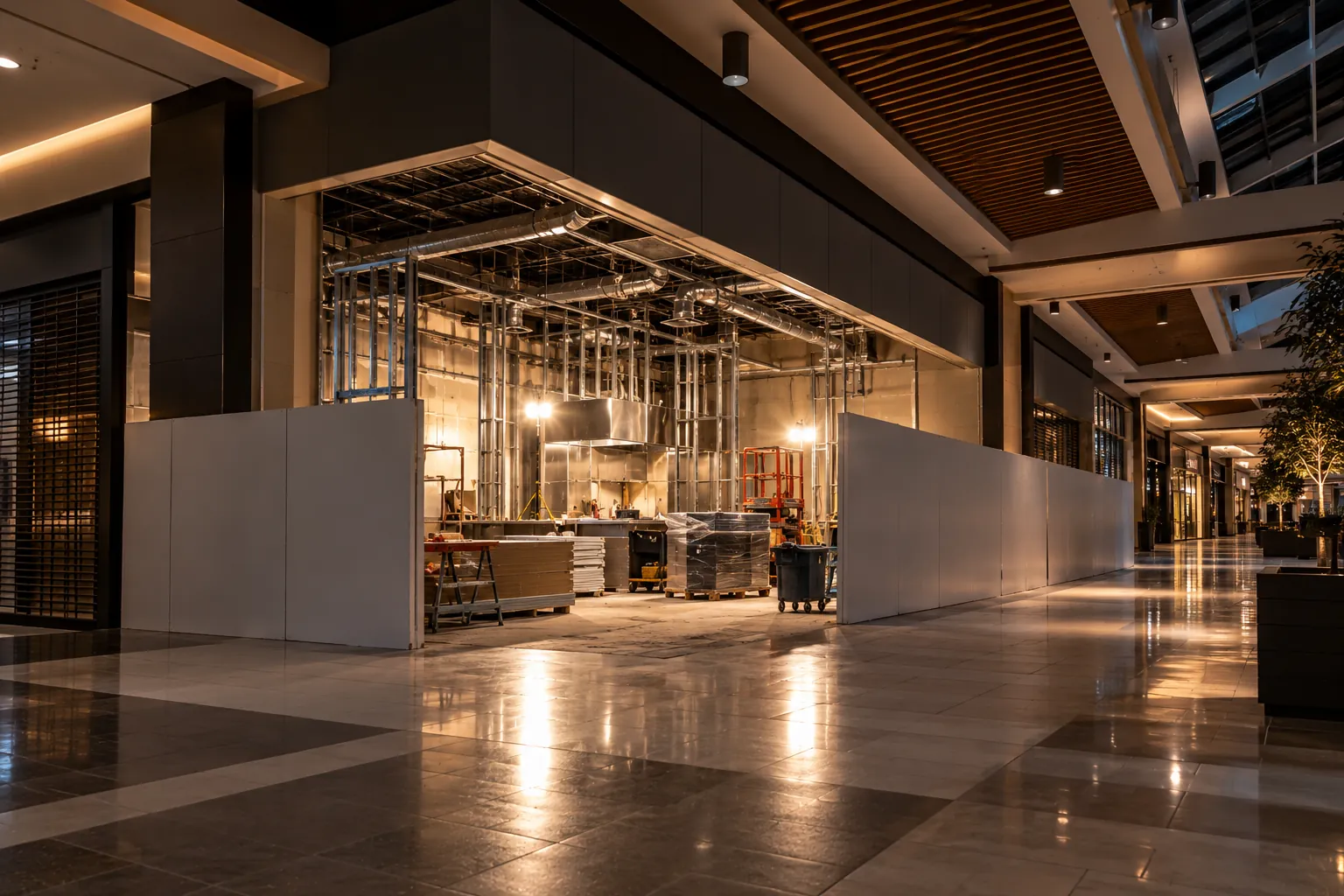
Food court restaurant construction looks simple on a leasing plan. In practice it is one of the most controlled builds in commercial construction: you share the floor, the ceiling, the sprinkler system, the exhaust path and the seating with the landlord and a dozen neighbours, so the landlord decides much of what you can build, who builds parts of it and when the work can happen.
For general restaurant scope and cost ranges, see our restaurant and QSR construction page. This article covers what changes when your unit sits inside a shopping centre or a downtown retail concourse. Published tenant manuals for Toronto properties show the pattern clearly:
| Item | What the criteria say | What it means for your build |
|---|---|---|
| Floor in front of the counter | Must be the base-building finish. Touch-ups are done by the landlord at the tenant's expense (2018). | You don't choose that floor, and you pay for the landlord's repairs. |
| Waterproofing | A waterproof membrane under non-slip finishes; the landlord's floor finish extends 6 inches past the lease line (2021, updated 2024). | The membrane is its own step, finished before tile goes down. |
| Kitchen exhaust | ULC-listed hood with fire suppression, welded ductwork to NFPA 96 and the Ontario Building Code; make-up air from the mall capped at 3,000 CFM per tenant unless the base-building engineer approves more (2018). | Your cooking line has to fit the air the landlord can supply. |
| Sprinklers and fire alarm | Tenants must use the base-building sprinkler and fire alarm contractors (2018; 2021–2024). | Part of your scope is priced by contractors you don't pick. |
| Hoarding | Installed by the landlord at the tenant's expense (2018; 2025). | A cost line to carry before the first day on site. |
| Construction deposit | 3% of construction value, $5,000 minimum, $10,000 maximum (2025) | Cash held until your closeout documents are in. |
Examples from tenant manuals published for First Canadian Place and Bay Adelaide Centre in downtown Toronto (see sources). They are not XBuilt quotes, and every landlord's package is different. Every project is priced after a site visit and a review of the landlord's criteria.
Grease handling is also set by the landlord. One manual requires every tenant to install a grease trap before connecting to the landlord's drains; another has the landlord maintain a central grease trap at the tenants' expense, with local traps the tenant's responsibility. Our article on grease interceptors in Toronto covers the City side, and commercial kitchen exhaust hoods in Ontario covers the hood.
02 — Approvals
Landlord review comes before the shovel
Published Toronto criteria use a two-step design review: a preliminary package with complete drawings and sample boards, then a final package. The landlord takes 10 business days to review each one, and partial submissions are not reviewed.
Work can only start once the lease is signed, the final drawings are approved in writing, the deposit is paid and insurance naming the landlord and property manager is in place. One 2025 manual asks the tenant's contractor for $5,000,000 in commercial general liability per occurrence, $2,000,000 in automobile coverage and a valid WSIB certificate. Ontario also requires the constructor to file a Notice of Project with the Ministry of Labour before work starts when labour and materials are expected to exceed $50,000.
Then comes the City. Toronto Building's Express Service aims to review eligible applications within 3 business days, for interior alterations to restaurants with fewer than 30 seats, up to 600 m², with no change in use or patron area. Restaurant tenant-improvement permits outside that stream typically issue in 4 to 7 weeks when the package is complete. For a full walk-through of a landlord package, read mall tenant criteria packages in Ontario, explained.
03 — Night work
Night work: when you can actually build
In an operating mall or concourse, most of the work happens after the stores close. One Toronto manual (2025) defines normal business hours as 7:30 a.m. to 6:30 p.m. Monday to Friday and 9:00 a.m. to 5:00 p.m. on Saturday, and requires tenant work to happen outside those hours unless the landlord approves otherwise in writing. Noisy work such as hammer drilling is after hours only. Coring or cutting above occupied floors waits until after 10:00 p.m., and slab x-rays happen between midnight and 6:00 a.m.
The City's noise rules
Toronto's Noise Bylaw (Chapter 591) does not allow clearly audible construction noise between 7 p.m. and 7 a.m. on weekdays, before 9 a.m. or after 7 p.m. on Saturdays, or at any time on Sundays and statutory holidays. The fine for construction noise outside those hours is $900.
| Rule | Weekdays | Saturday | Sunday and holidays |
|---|---|---|---|
| City Noise Bylaw: audible construction noise allowed | 7 a.m. – 7 p.m. | 9 a.m. – 7 p.m. | Not allowed |
| Landlord normal business hours: keep tenant work outside these | 7:30 a.m. – 6:30 p.m. | 9:00 a.m. – 5:00 p.m. | Not business hours |
The two rule sets can pull in opposite directions. The City's test is whether noise is clearly audible, and its page does not spell out how that applies inside an enclosed building, so where night work could be heard by neighbours, raise it early. The City asks for noise exemption applications 28 days before the work starts, most take three to four weeks, and fees run from $118.98 (Level 1) to $616.51 (Level 3). Permit holders must notify residents within 120 metres at least seven days ahead.
Fire and life-safety notices
The same 2025 manual requires 48 hours' written notice before heat- or dust-producing work such as welding, grinding, sanding or core drilling, so smoke detection can be isolated. A false alarm from unannounced work costs $1,000 per occurrence plus fire department costs. Sprinkler shutdowns need 72 hours' notice, and drain-down and recharge are billed to the tenant.
04 — Schedule
Tight schedules: what a realistic timeline looks like
Food court leases often fix the opening date, and the landlord's review adds steps a street-front restaurant doesn't have. For Toronto restaurants in general, 2026 market data gives these lease-to-opening ranges:
Lease signing to opening, Toronto restaurants
Typical range in weeks. Hover a bar for details.
Construction itself typically runs 6 to 8 weeks for a quick-service refresh, plus one to three weeks for inspections and a soft opening, and each permit resubmission can add two to three weeks. In a food court, add the landlord's two review rounds and night-only noisy work. See our restaurant build-out timeline for the full sequence.
How to protect the opening date
- Get the criteria package before you sign, and price the job against it
- Send the landlord complete packages; partial ones are not reviewed
- Bring the landlord's designated sprinkler and fire alarm contractors in early
- Order the hood, millwork and refrigeration as soon as drawings are approved
- Book loading dock and freight elevator time; one manual refuses unscheduled deliveries
Brands opening several food court units can standardize this through a multi-location rollout program.
05 — Closeout
Closeout: the paperwork that releases your deposit
The last step is easy to underestimate. One 2025 manual lists documents due before opening: final consultant inspection reports, the Certificate of Substantial Performance, sprinkler test certificates, the air balancing report, fire alarm verification, the final ESA certificate and confirmation that permits are closed. A second set, including as-built drawings and a statutory declaration that subcontractors are paid, is due within 60 days. If the closeout documents don't arrive within 60 days, the construction deposit is forfeited. Food tenants in another manual also owe a fire suppression verification certificate and an exhaust hood balancing report.
XBuilt manages permit and inspection coordination, deficiency completion and closeout as part of the build, and schedules site work outside regular hours when the landlord requires it. If you are planning a food court unit in Toronto, Mississauga, Vaughan or elsewhere in Ontario, request a quote and send us the landlord's criteria package with your drawings.
FAQ
Food court construction FAQ
Can food court construction happen during mall hours?
Usually only quiet work. Published Toronto landlord criteria require tenant work to happen outside normal business hours unless the landlord approves it in writing, and noisy work such as hammer drilling must be done after hours. Toronto's Noise Bylaw separately limits clearly audible construction noise to 7 a.m. to 7 p.m. on weekdays and 9 a.m. to 7 p.m. on Saturdays.
Who chooses the sprinkler and fire alarm contractor in a food court?
Often the landlord. Published Toronto criteria require tenants to use the base-building sprinkler and fire alarm contractors, at the tenant's expense. Your general contractor coordinates their work into the schedule.
How long does the landlord take to approve food court drawings?
Published Toronto criteria give the landlord 10 business days for the preliminary submission and 10 for the final submission, and incomplete packages are not reviewed. The building permit is handled after, or in parallel where the landlord allows it.
Sources
- First Canadian Place — Tenant Design & Construction Manual, TDCM100.11 (April 2025)
- Bay Adelaide Centre — Retail Tenant Design Criteria (2021, with 2023–2024 updates; posted 2025)
- First Canadian Place — Food Terrace Tenant Design Criteria Manual (2018)
- City of Toronto — Noise (Noise Bylaw, Chapter 591) (2026)
- City of Toronto — Noise exemption permit (2026)
- City of Toronto — Building permit review streams (2026)
- Government of Ontario — File a work notice (Notice of Project) (2026)
- CHI Real Estate — Toronto restaurant permits guide (2026)