Key takeaways
- Polished concrete refines the slab itself. Epoxy adds a coating on top. Sealed concrete relies on a sealer that needs periodic renewal.
- HomeStars' 2026 Canadian guide reports epoxy in industrial warehouses at CA$8–$15 per sq ft.
- Published lifespan claims vary widely, so judge each system against your traffic, chemicals and cleaning routine.
- The condition of the existing slab often decides the choice and the budget.
01 — Basics
Polished concrete, epoxy and sealed concrete: what each one is
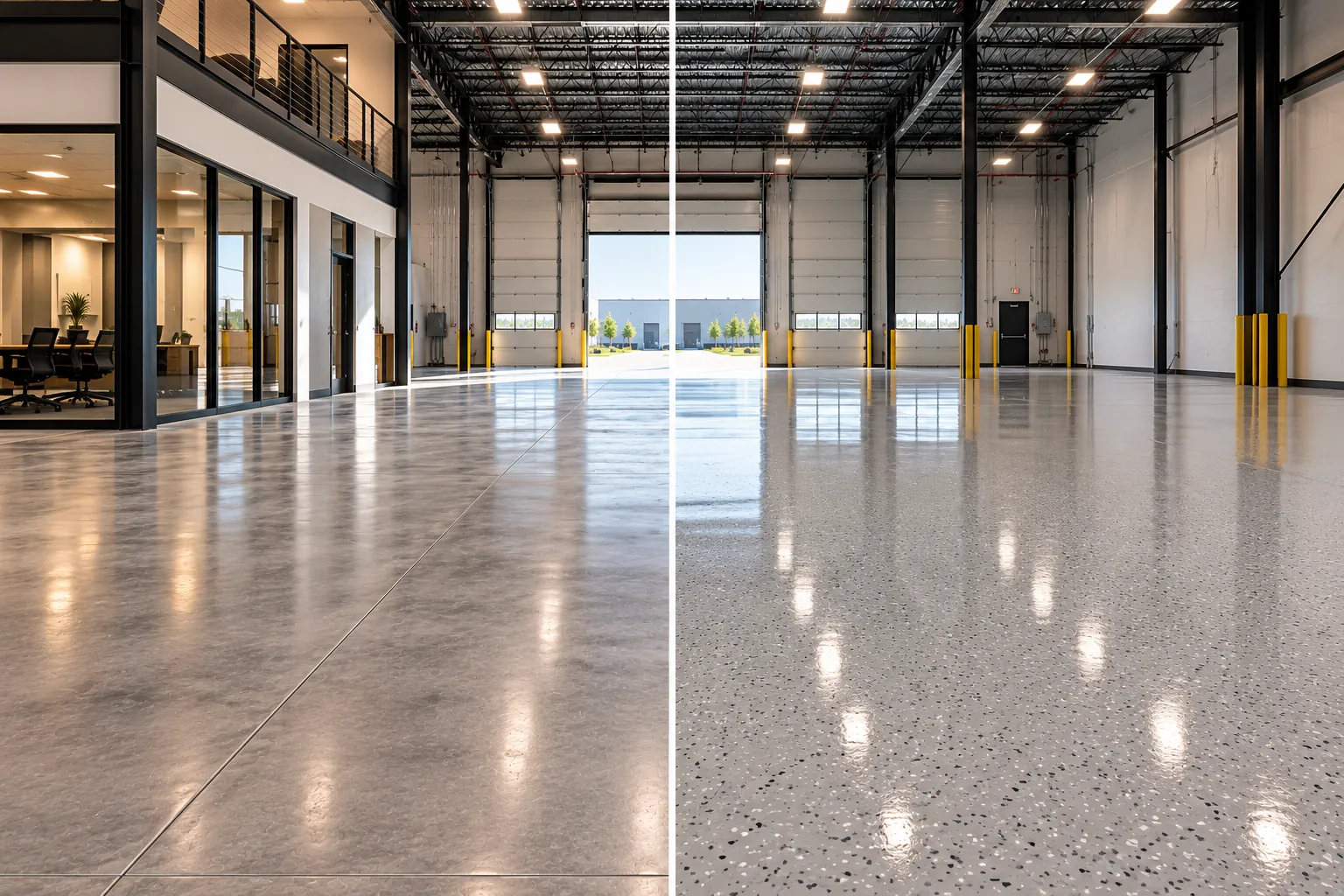
When facility managers compare polished concrete vs epoxy, they are really comparing two different ideas. One improves the concrete you already have. The other covers it with a new surface. Sealed concrete sits in between and is the lowest-cost way to protect a slab.
Polished concrete
The Concrete Polishing Association of America (CPAA) defines polishing as changing a concrete floor surface, with or without exposing aggregate, to achieve a specified level of gloss. Its definitions separate bonded abrasive polishing, which it says yields the most durable finish and needs the least maintenance, from burnished finishes, which are less durable. The CPAA also classifies gloss in four levels and aggregate exposure in four classes, so ask for both in the specification.
Epoxy coatings
Epoxy is a resin coating bonded to prepared concrete. Industry guidance describes it as forming a seamless, non-porous surface that resists wear, chemicals and heavy traffic and is easy to clean. Under the CPAA definitions, a coated floor is not polished concrete: its durability depends on the quality of the coating used.
Sealed concrete
Sealing protects a slab against stains and moisture without grinding it to a polish. A 2017 trade article on polished concrete maintenance explains the two broad types: film-forming "guards" act as a sacrificial wear layer that scuffs and needs reapplication, while penetrating protectors work below the surface, so there is nothing to abrade away and reapplications are further apart.
02 — Costs
How much does industrial flooring cost per square foot?
We could not find a Canadian public source that publishes polished concrete prices, so the table below shows each figure in the currency its source uses. Treat the US numbers as a guide to relative cost, not as Toronto pricing.
| System | Scope | Published range per sq ft |
|---|---|---|
| Epoxy, industrial warehouse | Canadian price guide, commercial and industrial category | CA$8 – $15 |
| Epoxy, office space | Canadian price guide | CA$5 – $10 |
| Polished concrete, simple | US national average, simple design | US$2 – $6 |
| Polished concrete, moderate | US national average | US$5 – $8 |
| Polished concrete, advanced | US national average, complex design | US$8 – $15 |
| Concrete sealing | US national average, sealer application | US$0.85 – $1.60 |
Two cost details matter for industrial floors. HomeAdvisor notes that each extra grinding pass for a higher shine adds US$3 to US$5 per sq ft, so the gloss level you specify changes the price. HomeStars notes that cleaning, repairs or moisture treatment can raise the cost of an epoxy floor.
Epoxy flooring cost by type of space
Canadian dollars per sq ft. Hover a bar for details.
These are market ranges compiled from public 2026 sources, shown to help you plan. They are not XBuilt quotes. Every project is priced after a site visit and a review of the existing slab.
03 — Performance
Durability and maintenance
Lifespan is where published sources disagree most, and it pays to read them critically. HomeStars says epoxy floors can last 20 years or more. BECOSAN, a company that sells polished concrete systems, says epoxy typically lasts 5 to 10 years. HomeAdvisor says polished concrete lasts 20 years or more when installed by professionals and properly maintained, and also says epoxy offers more durability and toughness than polished concrete, at a higher material and labour cost. The honest answer is that traffic, coating thickness, preparation and cleaning decide the real result.
Polished concrete
Refines the slab- No coating to peel or delaminate
- Routine care: entry matting, dust mopping and auto-scrubbing with suitable pads
- Periodic re-refining with engineered pads before wear shows
- Shows existing cracks, patches and stains
Epoxy coating
Covers the slab- Seamless, non-porous and easy to clean
- Resists chemicals and heavy traffic
- Can include colours and safety line markings
- Depends on surface preparation and the bond to the concrete
Maintenance guidance for polished floors is simple but strict: walk-off mats at entrances to stop grit and de-icing salt, fast spill cleanup, frequent dust mopping, and a cleaner made for polished concrete. Aggressive pads and stiff brushes wear the surface down.
04 — Selection
Choosing a floor system by area
Most facilities do not need one floor everywhere. A common approach is to match the system to what each zone has to withstand:
| Area | Main demands | Systems to consider |
|---|---|---|
| Warehouse aisles and racking | Forklift traffic, abrasion, dust control, large areas | Polished or sealed concrete |
| Production and wash-down areas | Spills, chemicals, frequent cleaning | Epoxy or other resinous coatings |
| Shipping docks | Salt and grit from trucks, heavy point loads | Sealed or polished concrete with strong entry matting |
| Warehouse offices and lunchrooms | Appearance, comfort, easy cleaning | Polished concrete, epoxy or conventional flooring and tile |
| Washrooms | Moisture, hygiene, slip resistance | Epoxy or tile |
If the floor is part of a bigger project, such as a warehouse office build-out, decide the flooring early so the slab work is sequenced before walls and finishes. For retail and restaurant floors, see our guide to durable finishes for high-traffic spaces.
05 — Existing conditions
Start with the slab you have
On renovation projects, the existing slab often makes the decision for you. Before choosing a system, have the floor assessed for:
- Cracks, spalls and failed joints that need repair first
- Old coatings, adhesives or sealers that must be removed
- Patches and stains that would show through a polished finish
- Moisture coming through the slab, which affects coatings
- Areas where the floor has to stay in service during the work
Floor work is noisy and dusty, and coated floors need time before traffic returns, so it is often scheduled into a shutdown window. Our article on renovating without stopping operations explains how. XBuilt handles concrete and flooring as part of our industrial construction work. Request a quote and we will review your slab and the way each area is used.
06 — FAQ
Industrial flooring FAQ
Is polished concrete cheaper than epoxy?
Often, but not always. HomeAdvisor's 2026 cost guide reports polished concrete at US$2 to US$16 per square foot in the United States, with simple finishes at US$2 to US$6. HomeStars' 2026 Canadian guide reports epoxy in industrial warehouses at CA$8 to CA$15 per square foot. The condition of the existing slab and the number of grinding passes move the price most.
How long does an epoxy floor last compared with polished concrete?
Sources disagree. HomeStars says epoxy floors can last 20 years or more, while BECOSAN, a maker of polished concrete systems, says epoxy typically lasts 5 to 10 years. HomeAdvisor says polished concrete lasts 20 years or more with proper care. Traffic, coating thickness, surface preparation and maintenance decide the real lifespan.
What is the difference between sealed and polished concrete?
Polished concrete is mechanically ground and refined to a specified level of gloss, and the Concrete Polishing Association of America says the bonded abrasive method yields the most durable finish. Sealed concrete relies on a sealer: film-forming guards wear away and need reapplication, while penetrating protectors work below the surface and last longer between applications.
Sources
- HomeStars — Epoxy flooring costs price guide (updated August 2026)
- HomeAdvisor — Polished concrete floor cost (updated June 2026)
- BECOSAN — Polished concrete floors cost guide 2025–2026
- For Construction Pros — Concrete Polishing Association clearly defines polishing processes
- For Construction Pros — Polished concrete maintenance (2017)
- Duraamen — Guide to choosing an industrial concrete coating (updated 2026)